
Solar PV inspection · with SolarMark
Thermal inspection that tells you which module to fix
Aerial infrared thermography of solar power plants, with classified anomalies, module and string references, and a report that an O&M team can act on the same week.

Solar inspection assignments are scoped and scheduled with SolarMark, whose platform handles plant onboarding, inspection planning and client reporting. Arkman Dynamics supplies the flight, thermal payload and processing capability.
What thermography finds
Faults that cost generation before they cost modules
Under load, a defective cell, diode or joint runs hotter than its neighbours. An infrared camera sees that temperature difference from the air, module by module, without walking kilometres of rows.
- Hot spots and cell defects — localised heating from cracked cells, poor soldering or shading.
- Bypass diode failures — characteristic hot bands across substrings that silently retire part of a module.
- String and combiner losses — whole strings or sections running colder, indicating open circuits or isolation.
- Soiling and vegetation shading — differential heating patterns that justify a cleaning cycle.
- Connection and junction box problems — high-resistance joints that become fire risks as well as yield losses.
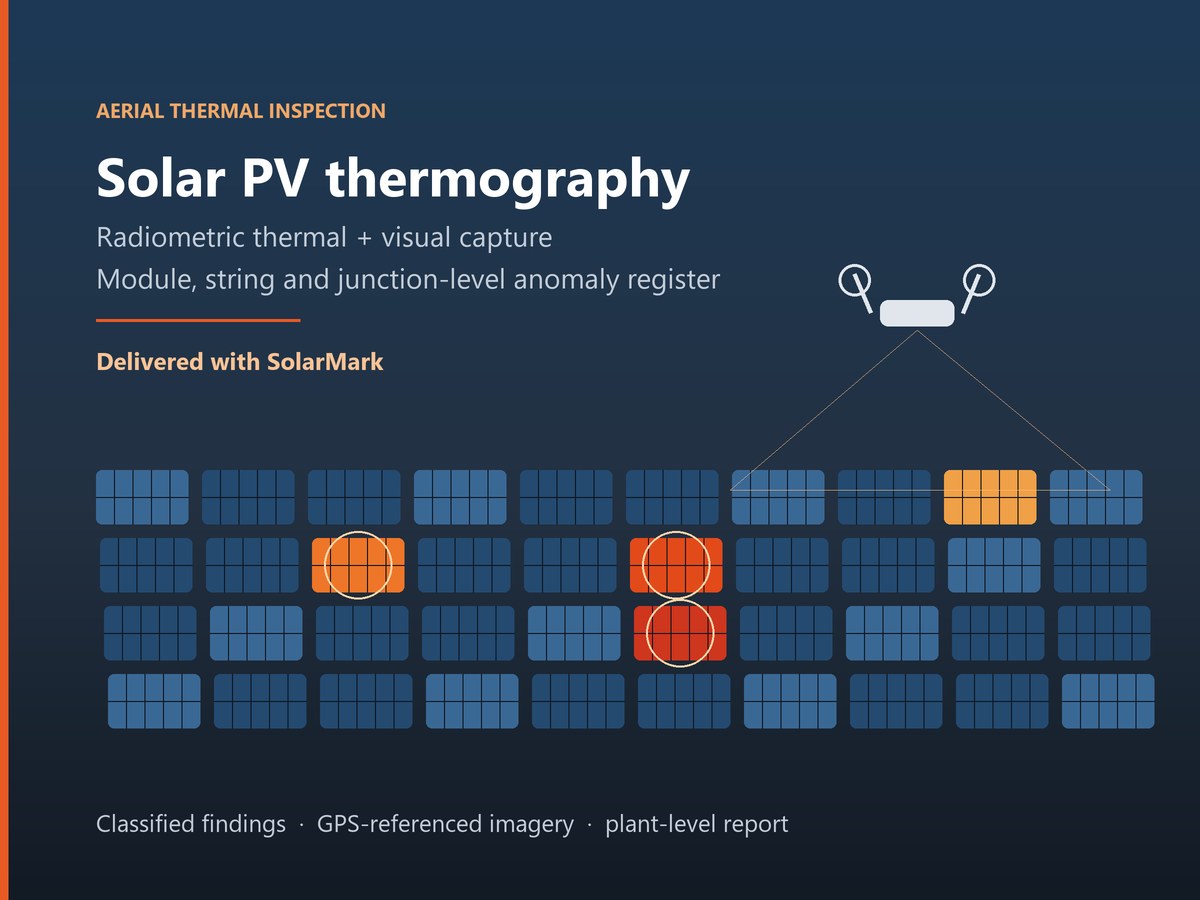
Anomaly classes
How findings are recorded
Every anomaly is logged with its location, thermal signature, severity and a recommended action so that maintenance can be prioritised instead of debated.
| Anomaly class | Indication | Indicative severity | Recommended action |
|---|---|---|---|
| Single hot spot | Localised cell heating, often cracking or soldering defect | Medium to high | Module-level audit, warranty claim evidence, replace if confirmed |
| Bypass diode fault | Heated band across one substring of a module | Medium | Check diode and junction box, verify string current |
| String outage | Whole string or section running cooler than loaded neighbours | High | Verify string fuse, connector and inverter input |
| Soiling pattern | Gradual, distributed temperature variation across the array | Low | Schedule module cleaning, re-inspect to confirm improvement |
| Connector / joint heat | Point heating at cable joints and combiner boxes | High | Immediate electrical inspection and torque-check |
| Substring mismatch | Uniformly elevated sub-array temperatures | Medium | Electrical testing, compare against string-level monitoring data |
Severity thresholds are agreed with the plant operator before the inspection and applied consistently across all tables in the report.
Workflow
From plant list to maintenance plan
-
Plant data & scope
Array layout, capacity, string configuration and access constraints are collected; the operator confirms which sections are in scope.
-
Inspection plan
Flight lines, altitude and capture geometry are planned over the module rows, with thermal and visual sensors acquiring simultaneously.
-
Acquisition under load
The array is inspected while generating, so faults reveal themselves as temperature contrast. Conditions and irradiance are recorded for the report.
-
Radiometric processing
Thermal frames are corrected and mosaicked, anomalies detected and classified against the agreed severity thresholds, then referenced to module and string positions.
-
Report & action register
Delivered as a plant report plus a sortable anomaly register with imagery, coordinates, severity and recommended repair action.
Deliverables
What the O&M team receives
- Anomaly register as XLSX/CSV: ID, block, row, string, module, coordinates, class, severity and recommended action.
- Thermal image set for every recorded anomaly, cropped to the affected module or string.
- Visual reference images of the same locations for field identification.
- Thermal orthomosaic of the inspected blocks for plant-wide review.
- Plant report covering method, conditions, findings, statistics and priorities.
- Warranty support pack on request, for defects pursued with module suppliers.
- Re-inspection comparison against previous inspections, to confirm that corrective work resolved the findings.
Good to know
- Inspect under loadThermography needs the array generating, so inspections are flown while the plant is producing, in line with site safety rules.
- Right conditionsClear sky with steady irradiance gives the clearest contrast between healthy and faulty modules; marginal days are still usable and are noted in the report.
- Expandable scopeWhere a plant has structural or drainage issues, the same mobilisation can add visual asset inspection and orthophoto coverage.
Inspection questions
Practical points for plant owners
How often should a plant be inspected?
Most operators inspect annually, with additional surveys after commissioning, major weather events, cleaning cycles or unexplained generation shortfalls. Plants in high-dust or high-humidity locations often benefit from a shorter interval.
Will the inspection interrupt generation?
No. The plant keeps running and the drone flies above the array. Flights are planned around site safety procedures and the operator's work permit system; no array section is taken out of service for the survey itself.
Can the findings be used for warranty claims?
Yes. Each anomaly is documented with thermal and visual imagery, position and severity, which is the evidence set module suppliers normally ask for. Affected modules can be packaged as a separate submission.
Do you inspect both rooftop and ground-mount plants?
Yes. Rooftop, ground-mount and tracker installations are all suitable, subject to access and safe flight clearances over the specific site.
Schedule a solar PV inspection
Send the plant capacity, location and preferred window. We will confirm feasibility, mobilisation and the reporting format before the survey date.